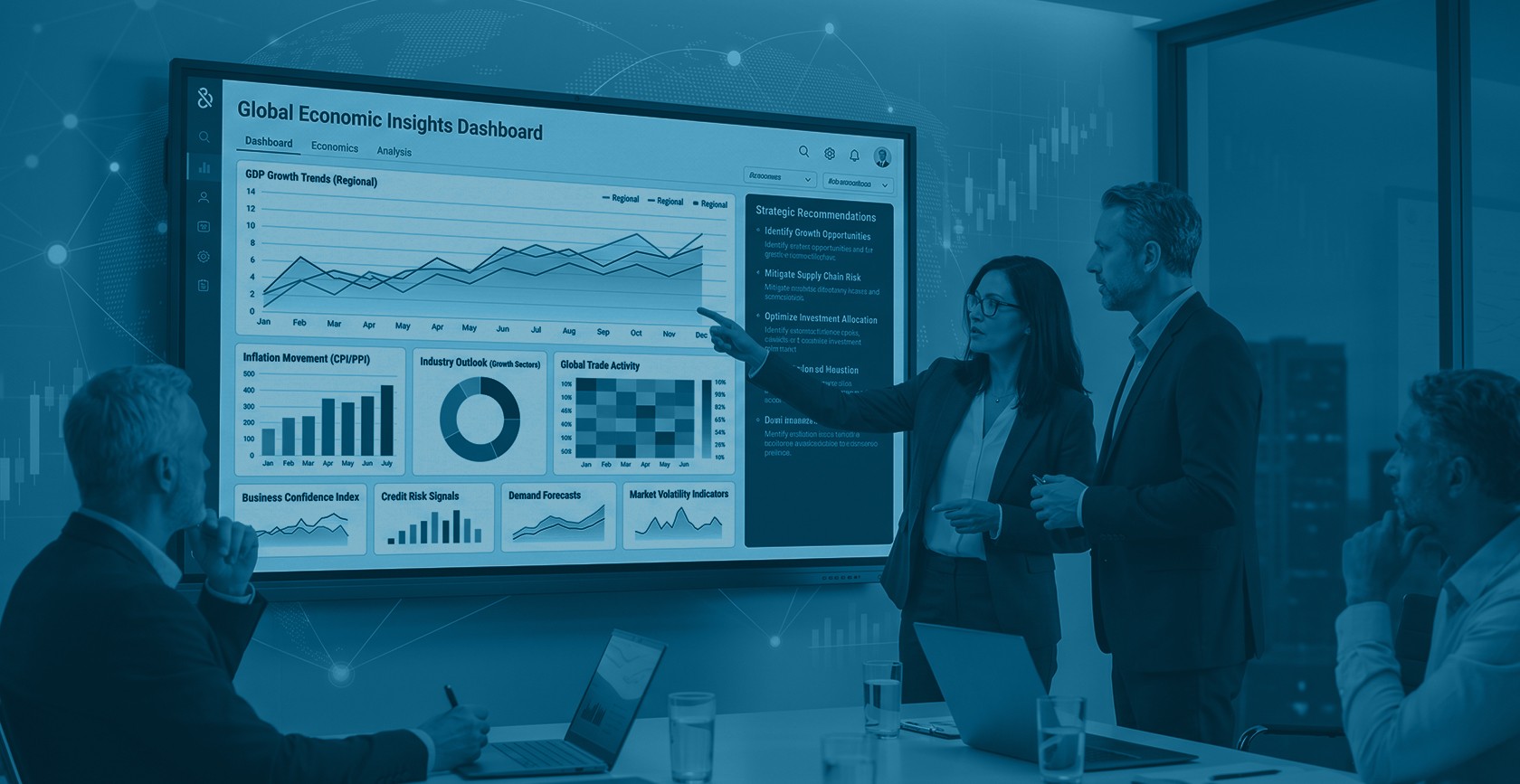
Every business decision carries economic assumptions. When you set a price, enter a new market, extend credit to a customer, or plan a hiring cycle, you are implicitly betting on where the economy is headed. The question is not whether economics shapes your decisions. It already does. The question is whether you are making those bets with structured intelligence or with instinct alone.
Economic Research is the systematic process of collecting, analysing, and interpreting economic data to understand current conditions and anticipate future trends. For business leaders, it is not an academic exercise. It is a practical discipline that reduces uncertainty, sharpens forecasting, and informs every major strategic call a company makes. This article covers the indicators that matter most, how to assess economic risk, where to find reliable data, and how to embed economic analysis into the way your business actually operates.
Why Economic Research Matters for Business Leaders
Macroeconomic conditions do not stay in the background. They move into your income statement, your credit portfolio, and your customer demand curves. When inflation spikes, input costs rise faster than pricing can absorb. When interest rates tighten, the cost of capital increases, and capital expenditure decisions get harder to justify. When unemployment falls sharply, labour markets tighten, and wage pressure follows. None of these is an unpredictable event. They are signalled, often months in advance, by publicly available, systematically tracked economic indicators.
Business leaders who monitor these signals hold a clear advantage. They adjust pricing before margin pressure becomes critical. They time market entry around economic cycles rather than against them. They extend or tighten credit terms based on counterparty risk signals rather than on trust alone. Business economics research is not about predicting the future with certainty. It is about narrowing the range of assumptions your strategy rests on, so that decisions are built on evidence rather than exposure.
Key Economic Indicators Every Executive Should Monitor
Not every economic indicator is equally relevant to every business. But there is a core set that applies broadly across sectors, geographies, and company sizes.
Growth indicators
Gross Domestic Product (GDP) is the broadest measure of economic output. Sustained GDP growth signals expanding consumer and business spending, which typically supports revenue growth. A contracting GDP signals reduced demand, tighter budgets, and higher credit risk across the economy. The Purchasing Managers Index (PMI) is a faster-moving signal: a PMI above 50 indicates expansion in manufacturing or services activity; below 50 indicates contraction. Because PMI data is released monthly and reflects current business conditions, it is one of the most useful near-term indicators for strategic planning.
Price stability indicators
The Consumer Price Index (CPI) measures changes in the price of a basket of goods and services paid by consumers. Rising CPI indicates inflation, which affects input costs, consumer purchasing power, and central bank policy. The Producer Price Index (PPI) tracks price changes at the production level, often acting as a leading indicator of consumer inflation. Both matter to business leaders assessing margin pressure and pricing strategy.
Labour market signals
The unemployment rate measures the share of the workforce actively seeking but unable to find work. Low unemployment signals a tight labour market, which increases wage pressure and hiring costs. Rising unemployment can signal weakening demand and precede a downturn in consumer spending. Wage growth data adds further context, particularly for labour-intensive businesses.
Monetary policy signals
Central bank interest rate decisions are among the most consequential economic signals for business. Rate increases raise the cost of borrowing, reduce investment appetite, and can slow economic activity. Rate cuts ease financing conditions and tend to stimulate activity. Tracking central bank forward guidance, not just current rate decisions, allows businesses to anticipate the direction of monetary policy before it affects their cost of capital.
Understanding the Global Economic Outlook and its Business Impact
Individual indicators tell part of the story. The global economic outlook provides the context in which those indicators make sense.
For businesses with international operations, supplier networks, or export markets, macroeconomic conditions in one region can directly transmit into operations in another. A slowdown in a major manufacturing economy affects global supply chains. A shift in trade policy between large trading blocs changes the cost structure for importers and exporters. A geopolitical shock in an energy-producing region moves fuel and logistics costs within weeks.
Even businesses that operate entirely within a single domestic market are not insulated from global conditions. Currency movements affect the cost of imported inputs. Global commodity price shifts pass through to local suppliers. Tightening financial conditions in major economies can reduce the availability of credit domestically.
The practical implication is that economic risk assessment should always include a global layer. Businesses need to track not just their own market's indicators but the economic conditions of their key trading partners, their suppliers' geographies, and the major economies whose policy decisions drive global financial conditions. A business operating in the Gulf, for instance, cannot assess its risk environment without accounting for oil price dynamics, US Federal Reserve policy, and regional trade flows.
How to Conduct an Economic Risk Assessment for Your Business
Economic risk assessment identifies which economic variables have the greatest potential impact on your business and stress-tests your plans against adverse scenarios in those variables.
Start with exposure mapping: a structured review of which economic conditions your revenue, costs, and cash flow are most sensitive to. A consumer-facing business is highly sensitive to consumer confidence and disposable income. A business carrying significant trade receivables is sensitive to credit conditions and counterparty financial health. A business with overseas revenues is sensitive to exchange rate movements.
From there, build scenarios. Rather than planning around a single forecast, model at least three paths: a base case aligned with consensus expectations, a downside case reflecting a plausible adverse shift such as recession, sustained inflation, or credit tightening, and an upside case. Each should carry explicit economic assumptions with corresponding adjustments to revenue, costs, and liquidity.
Economic risk assessment should be a live process, not a one-off exercise at budget time. A regular review cadence, whether quarterly or triggered by major indicator releases, is the difference between proactive risk management and reactive firefighting.
Reliable Economic Data Sources for Businesses
The credibility of your economic analysis depends on the quality of the data behind it. There is no shortage of economic commentary, but reliable, structured, and regularly updated sources are more limited.
Multilateral institutions are the foundation. The IMF, World Bank, and OECD publish GDP projections, inflation forecasts, labour market data, and country-level analysis on a regular basis. National statistical agencies and central banks add granularity at the market level, with monetary policy statements and financial stability reviews among the most forward-looking documents available for free.
For businesses that need economic data integrated with company-level and credit risk intelligence, commercial business information platforms connect macroeconomic conditions with counterparty risk signals. Industry associations and sector-specific research bodies complement this with economic research reports for executives tailored to specific verticals.
When evaluating any source, the criteria that matter are update frequency, methodology transparency, geographic coverage, and whether the data is primary or aggregated.
Applying Economic Research to Business Strategy: A Practical Approach
Economic research creates value only when it reaches the people making decisions, in a form they can act on. Three steps make that happen.
First, establish a regular economic briefing function. This does not require a dedicated economist, just someone in finance or strategy with the remit to monitor key indicators and translate findings into business-relevant implications.
Second, integrate economic assumptions explicitly into financial planning. Each budget and quarterly forecast should state its assumed inflation rate, interest rate path, and GDP growth rate. When conditions deviate, the variance is immediately visible.
Third, extend economic intelligence beyond finance. Sales, procurement, and HR all make decisions that economic signals inform. The value of economic research multiplies when it becomes a shared organisational input rather than a siloed function.
Conclusion
Economic research is a leadership competency. The business leaders who treat it as one, who monitor indicators systematically, assess risk against structured scenarios, and apply economic intelligence across the organisation, carry a measurable advantage in timing, resilience, and strategic clarity over those who rely on intuition alone.
The data is available. The frameworks are straightforward. What separates businesses that benefit from economic research from those that do not is the discipline to build it into regular practice.
To understand how structured business intelligence can support your economic risk assessment and inform decisions across your organisation, speak to our team.
Get the latest economic research reports for your sector. Speak to our team today.
FAQs
Q: What is economic research, and why is it important for businesses?
A: Economic research is the systematic collection and analysis of economic data, including indicators, trends, forecasts, and policy developments, to inform decision-making. It is important for businesses because macroeconomic conditions directly affect demand, costs, credit conditions, and competitive dynamics. Leaders who monitor economic signals make better-timed and better-grounded strategic decisions.
Q: What are the most important economic indicators for business leaders to track?
A: The indicators with the broadest strategic relevance are GDP growth, PMI, CPI, PPI, unemployment rate, wage growth, and central bank interest rate decisions. The relative importance of each depends on the business model and sector, but these seven cover the core dimensions of growth, pricing, labour, and financing conditions.
Q: How does economic research differ from market research?
A: Market research focuses on customer behaviour, competitive positioning, and product-level demand within a specific industry or segment. Economic research operates at a macro level, covering the broader conditions that shape the environment in which all businesses operate. Both are necessary. Economic research provides the context; market research provides the specifics.
Q: What is economic risk assessment, and how is it done?
A: Economic risk assessment identifies which economic variables your business is most exposed to and models the impact of adverse changes in those variables on revenue, costs, and cash flow. It typically involves exposure mapping, scenario construction across base, downside, and upside cases, and integration of economic assumptions into financial planning cycles.
Q: Where can businesses access reliable economic data and research reports?
A: Reliable sources include the IMF, World Bank, OECD, national central banks, and government statistical agencies for macro data. Commercial business information platforms provide economic data integrated with company-level and credit risk intelligence. Industry associations publish sector-specific economic research reports for executives that translate aggregate data into sector-relevant insight.
Q: How does the global economic outlook affect business planning?
A: The global economic outlook shapes the conditions in which domestic businesses operate, even those without direct international exposure. Global commodity prices, trade flows, currency movements, and the monetary policy of major central banks all transmit into local cost structures, credit availability, and demand. Businesses with cross-border operations or supply chains carry direct exposure to regional economic conditions and need to track the global outlook as a core part of their risk assessment process.