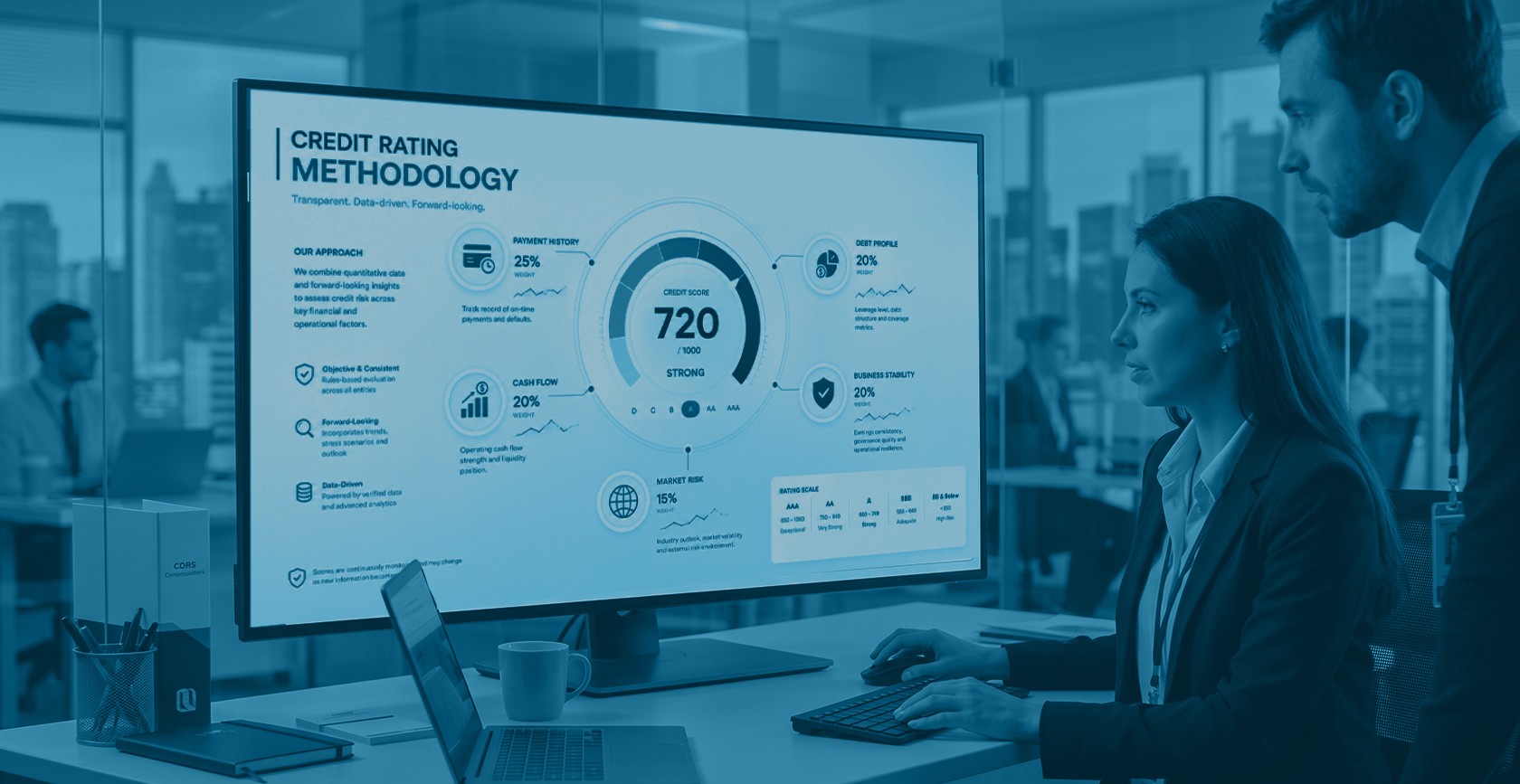
Credit Rating Methodology is the structured process a rating agency uses to evaluate a business's payment behavior, financial health, and risk profile, and convert that assessment into a credit score.
For Egyptian businesses, D&B is the primary source of this assessment. The score that results from this methodology affects trade credit access, supplier terms, procurement eligibility, and cross-border deal qualification. Understanding the methodology is the first step toward managing the outcome.
This article covers:
- What D&B measures when rating a business in Egypt
- How each factor is weighted in the methodology
- What actions produce measurable score improvement
What Is Credit Rating Methodology?
Credit rating methodology is the framework a credit rating agency uses to evaluate the financial health and payment reliability of a business entity. It defines which data sources are used, how each factor is weighted, and how the final rating is derived.
For business credit, this is fundamentally different from personal credit scoring. A personal credit score reflects an individual's borrowing and repayment behavior. A business credit rating reflects the financial health assessment of a legal entity: its structure, its track record with trade creditors, its public legal standing, and the risk context of the industry it operates in.
D&B's credit rating methodology is applied consistently across markets. In Egypt, the same core framework is used, with adjustments that account for local data availability, sector concentration, and market-specific risk factors. The result is a standardized business credit score that can be interpreted and relied upon by buyers, suppliers, and financial institutions anywhere in the world.
What makes this methodology valuable is its transparency. When you understand what goes into the score, you understand what to fix.
How D&B's Credit Rating Methodology Works in Egypt
D&B builds a credit profile for every business entity that holds a D-U-N-S Number. That profile aggregates data from multiple sources and runs it through a structured evaluation process. The output includes several distinct scores and indicators, each measuring a different dimension of business credit risk.
Payment History Analysis
Payment behavior is the most heavily weighted factor in D&B's methodology. It is captured in the PAYDEX score, a numeric scale from 1 to 100 that reflects how promptly a business pays its suppliers and trade creditors.
A PAYDEX score of 80 indicates payments made exactly on time. Scores above 80 reflect early payment, which is treated as a positive signal. Scores below 80 indicate late payment at varying degrees, with lower scores corresponding to longer payment delays.
The data that feeds the PAYDEX score comes from trade references reported by suppliers and creditors. If your suppliers are not reporting payment data to D&B, your PAYDEX score cannot be accurately calculated, regardless of how reliably you pay. This is one of the most common and most correctable causes of a weaker-than-expected business credit score.
Financial Health Assessment
Where financial statements are available, D&B factors in liquidity ratios, leverage, and profitability indicators as part of its broader financial health assessment. For Egyptian businesses, submitting audited financial data significantly strengthens the credit profile.
Companies that do not share financial data are assessed on incomplete information, which typically results in a more conservative, higher-risk classification. This is not a penalty in the traditional sense, but a default response to uncertainty. The methodology treats data absence as a risk signal, not a neutral condition.
Company Profile and Structure
Company age, legal structure, number of employees, years in operation, and ownership structure all contribute to the overall rating. Older businesses with stable structures carry lower inherent risk under D&B's methodology. Newly registered Egyptian entities typically start with limited scores that develop over time as data accumulates.
This factor rewards longevity and consistency. It also means that new businesses need to be especially proactive about building their credit profile from the start rather than waiting for scores to develop organically.
Public Records and Legal Standing
D&B incorporates public records into its credit risk assessment. These include court judgments, defaults, liens, and legal filings accessible through official commercial registries and legal databases in Egypt. A single unresolved judgment can materially suppress an otherwise healthy score.
The impact of a negative public record is asymmetric: it is easier for a public record to drag a score down than for positive payment data to bring it back up in the short term. This is why resolving outstanding legal matters and maintaining clean documentation is not just good legal hygiene but a direct credit management responsibility.
Industry and Geographic Risk
D&B applies sector-level risk adjustments based on the default rates and financial volatility associated with specific industries. Geographic risk factors relevant to Egypt include currency exposure, sector concentration in the local economy, and the data availability gaps that are particularly common among Egyptian SMEs.
These adjustments are applied contextually and reflect the reality that a business operating in a structurally higher-risk sector faces different external pressures than one in a more stable industry. This does not make the score unfair; it makes the credit risk assessment more accurate.
How the Factors Are Weighted
Not all inputs carry equal influence over the final score. Understanding the relative weight of each factor helps businesses prioritize where to focus their improvement efforts.
Payment history dominates. A strong PAYDEX score can offset thin financial data to a meaningful degree because it is the most directly verifiable and continuously updated factor in the methodology. Financial ratios carry greater influence when full data is submitted. Public records function as a floor: a negative record can suppress a score regardless of strong performance elsewhere.
| Factor | Weight influence | Primary data source |
|---|---|---|
| Payment history (PAYDEX) | Highest | Supplier trade references |
| Financial health indicators | High when data is available | Audited financials |
| Company profile and structure | Moderate | Registration and company data |
| Public legal records | Suppressive | Commercial registries |
| Industry and geographic risk | Contextual | D&B proprietary data |
The practical implication for Egyptian businesses is clear: consistent, on-time payment reported across multiple trade references is the highest-return action available. It directly addresses the most heavily weighted component of the methodology and it produces measurable score improvement faster than most other interventions.
Why Company Creditworthiness Is Increasingly Critical in Egypt
The business environment in Egypt is evolving. More multinational buyers, more cross-border procurement, and more structured supplier qualification processes mean that company creditworthiness is evaluated at more touchpoints than it was five years ago.
A business credit report from D&B is now a standard input in several commercial contexts: Trade credit and supplier relationships. Suppliers use D&B ratings to determine payment terms and credit limits before extending trade credit. Businesses with low or absent ratings are routinely asked to pay upfront or provide collateral, increasing working capital pressure
Procurement Qualification
Multinational companies operating in Egypt increasingly run D&B checks as a standard step in their supplier onboarding process. A missing or incomplete D&B profile creates friction in that process regardless of the supplier's actual financial strength.
Export and Cross-Border Deals
International buyers often require a minimum PAYDEX score or a satisfactory D&B credit rating as a precondition for entering a supply agreement. An Egyptian exporter without a credible D&B profile may lose deals to competitors who have invested in maintaining theirs.
Institutional Tenders
Government and large institutional procurement processes in Egypt and across the MENA region increasingly reference creditworthiness as a formal eligibility criterion.
How to Improve Your Business Credit Score Under This Methodology
Understanding the credit rating methodology translates directly into a practical improvement roadmap. These are the steps with the highest impact:
- Register and verify your D-U-N-S Number
Without a D-U-N-S Number, D&B cannot build or maintain a credit profile for your business. This is the foundational step for any Egyptian company that wants to establish or improve its standing.
- Submit trade references proactively
Ask your key suppliers and creditors to report payment history to D&B. This is the fastest and most direct route to improving your PAYDEX score. Businesses with even three to five consistent trade references have a meaningfully stronger profile than those with none.
- Submit audited financial statements
Financial data submission adds depth to your profile and shifts your classification from data-incomplete to data-assessed. This reduces the conservative risk adjustment applied by default and gives D&B's credit risk assessment more to work with.
- Resolve outstanding public record issues
Court judgments and liens should be settled and the resolution formally documented. D&B updates public record data when official sources reflect the change. Keeping documentation of resolved legal matters speeds up this process.
- Review your D&B profile for accuracy
Errors in company size, structure, or payment history do occur. An inaccurate profile may be reflecting a different entity's data or outdated registration information. Reviewing and correcting your profile is a direct route to score improvement when inaccuracy is the underlying cause.
- Pay early where operationally possible
PAYDEX scores above 80 reflect on-time payment. Scores moving toward 100 reflect early payment. Where cash flow allows, early payment to suppliers who report to D&B is one of the most direct ways to push the PAYDEX score toward the highest range.
Improvement is not instantaneous. A new trade reference typically updates within 30 to 90 days of submission. Sustained improvement across multiple trade references, built over 6 to 12 months, produces the most durable and credible score gains.
Conclusion
Credit rating methodology is not an abstract concept. It is a practical system that determines how your business is perceived by every supplier, buyer, and financial institution that looks up your D&B profile. The businesses that perform well within it do so not because they are the most profitable, but because they treat their credit profile as an asset that needs to be built and maintained.
For Egyptian businesses operating in increasingly competitive and internationally connected markets, a credible business credit score is no longer optional. It is a baseline requirement for trade credit access, procurement qualification, and cross-border growth.
The first step is understanding what drives your score. The second is acting on it.
Ready to assess or strengthen your business credit profile in Egypt? Contact D&B to access your Business Information Report and get a clear view of how your company is currently rated.
FAQs
Q: How is a business credit score calculated in Egypt?
A: A business credit score in Egypt is calculated using payment history, financial data, company structure, and public records. D&B applies a structured credit rating methodology that weights payment behavior most heavily through the PAYDEX score. Businesses with complete trade references and submitted financials receive more accurate and typically stronger ratings than those with incomplete data.
Q: What data does D&B use to rate companies in Egypt?
A: D&B uses trade payment references from suppliers, audited financial statements where available, company registration and structural data, public legal records, and industry risk classifications. In Egypt, data availability for SMEs is often limited, which can result in conservative default ratings. Businesses that proactively share data with D&B receive more complete and representative scores.
Q: What is the difference between a PAYDEX score and a D&B credit rating?
A: The PAYDEX score is a single-metric indicator, scored from 1 to 100, that measures payment promptness based on trade references. A D&B credit rating is a broader assessment that incorporates financial health, company profile, public records, and industry risk in addition to payment behavior. The PAYDEX score is one input into the overall credit rating, not the rating itself.
Q: Does D&B credit rating affect trade credit terms with suppliers in Egypt?
A: Yes. Suppliers and trade creditors, particularly multinationals operating in Egypt, use D&B credit ratings to determine payment terms, credit limits, and supplier approval decisions. A higher rating typically results in more favorable net payment terms and higher credit limits. Businesses with low or absent ratings may be required to pay upfront or provide collateral before credit terms are extended.
Q: Can a business with no credit history get a D&B rating?
A: Yes, but the rating will reflect limited data. D&B assigns a profile to any registered business with a D-U-N-S Number, even without trade references or financial submissions. A profile built on minimal data typically carries a higher risk classification. The most effective way to build a credible rating from zero is to register a D-U-N-S Number, submit at least one trade reference, and provide accurate company information.
Q: Why is my D&B credit score lower than expected?
A: The most common reasons are: no trade references submitted, an unresolved public record such as a judgment or lien, outdated or missing financial data, or inaccurate company profile information. In some cases, scores are suppressed because a business shares a name or address with a higher-risk entity. Reviewing your D&B profile for data errors is the first step before drawing conclusions about the score itself.
Q: How long does it take to improve a D&B business credit score?
A: A new trade reference can update your PAYDEX score within 30 to 90 days of submission. Resolving a public record dispute may take longer depending on the legal process involved. Consistent on-time or early payment, reported across multiple trade references over 6 to 12 months, produces the most durable score improvement.
Q: How do I dispute an inaccurate credit rating from D&B?
A: Contact D&B directly through their data dispute or profile update process. You will need to provide supporting documentation such as payment records, company registration details, or court discharge documents for resolved legal matters. D&B reviews disputes and updates the profile when evidence supports a correction. Keeping documentation of payments and resolving disputes on file makes this process significantly faster.